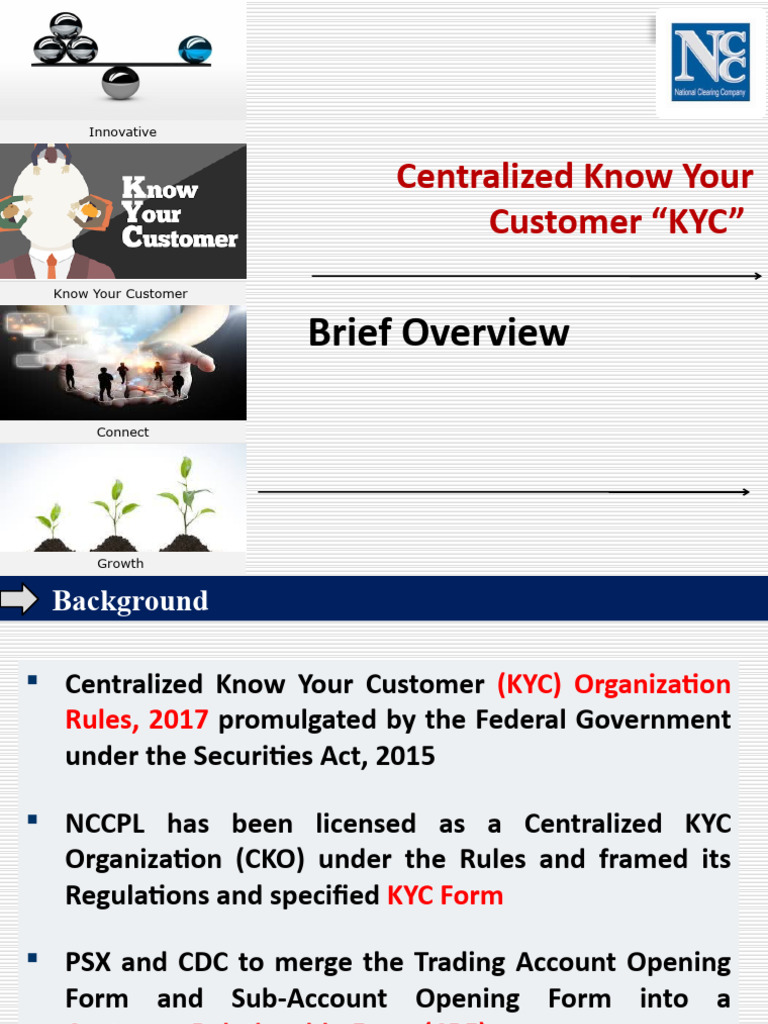
Know Your Customer Kyc
Executive Summary
Looking for details on Know Your Customer Kyc? You're in the right place. This collection features 10 research snippets and 8 media assets focused on Know Your Customer Kyc, complemented by 10 similar topics.
People searching for "Know Your Customer Kyc" are also interested in: "Know about" vs. "know of", to know vs to know about, “aware” vs “know”, and more.
Visual Analysis
Data Feed: 8 UnitsKnow Your Customer (KYC) | PDF | Authentication | Biometrics
KYC - Know Your Customer Acronym Stock Illustration - Illustration of ...
KYC Know Your Customer Definition Know Your Customer
Kyc (know your customer) | PPTX
Kyc (know your customer) | PPTX
KYC stands for Know Your Customer | Abbreviation Finder
Know Your Customer (KYC)
Business concept of KYC Know Your Customer. Stock Photo | Adobe Stock
Intelligence Data
Recently one of my friends told me that there is distinct difference between 'know of something' and 'know about something' expressions. 'know of' is used when you have personal experience with wha...
Possible duplicate of "Know about" vs. "know of". Also What are the differences between “know”, “know about”, and “know of”? on English Language Learners, which is probably a better site for questions …
For me, know implies knowledge of details or individual pieces, while am aware of implies a knowledge only of a whole. Using your example, knowing my rights means that I know I have the right to remain …
Jun 9, 2024 · Why do you think that He doesn't know him from his schooldays means that he does know him? It would only have that sense if you added something like In fact, he first met him at university.
Feb 25, 2012 · What is the correct usage of phrase "you don't know what you don't know"? Can it be used in formal conversation/writing?
Mar 25, 2015 · Possibly, "I do know that" can in fact only be used, when, you are answering the question of whether or not you know the issue at hand (or your knowledge has been called in to question, and …
Apr 22, 2014 · Just now when editing a post on another SE site that seemed to be written by a non-native speaker I was going to change "to know something inside and out" to "to know something …
For a non-native speaker like me, I am always wondering how to use you know correctly, as in the following sentence: Alright, well, for example, like on Saturdays, y’know, what I liked to do ...
Jan 3, 2020 · or "I know who that is" in a phone conversation. We use the determiner this to refer to someone whose voice we literally hold in our hand. A third party, hearing us on the phone, might ask …
Therefore, saying "did you know" asks if you have previously known something. "Do" is the present tense, so saying "do you know" would ask if you currently know.
Helpful Intelligence?
Our AI expert system uses your verification to refine future results for Know Your Customer Kyc.